Antenora
Antenora is the second of four concentric divisions within the Ninth Circle of Hell, a frozen lake reserved for traitors to their country or political party. Named after the Trojan prince Antenor, whom medieval tradition regarded as a traitor, this zone is distinguished by its punishment of immersion in ice up to the head, with the most notorious inmates including Bocca degli Abati, Buoso da Duera, and the eternally gnawing pair of Count Ugolino and Archbishop Ruggieri.
Location and Structure
Antenora occupies the second of four concentric rings — Caina, Antenora, Ptolomaea, and Judecca — that together form the frozen lake of Cocytus at the bottom of Hell. The ice in Antenora is so thick that even the fall of a mountain would not crack it. The sinners stand fixed in the ice up to their heads, their faces bent downward, their teeth chattering like storks. The cold is so intense that tears freeze over the eyes, forming a crystal visor that seals grief inward. This zone is reached after passing through Caina, the first division, where traitors to kindred are punished. The transition is marked by a change in the posture of the damned: in Antenora the heads are held higher, but the torment is no less severe.
Inhabitants and Punishments
The most prominent soul encountered in Antenora is Bocca degli Abati, a Florentine Ghibelline who betrayed his city at the Battle of Montaperti. When Dante accidentally kicks his face while walking among the frozen heads, Bocca refuses to give his name, even after Dante tears out handfuls of his hair. Only when another sinner calls out "Bocca" does Dante learn his identity. Bocca then spitefully names other traitors: Buoso da Duera, who accepted French bribes to betray the Ghibelline cause; Beccaria, a Florentine chancellor whose throat was slit for treachery; Gianni del Soldanier; Ganelon, the betrayer of Roland; and Tebaldello, who opened the gates of Faenza to the Guelphs while the city slept. The punishment of Antenora is perpetual exposure in the ice, with the cold serving as a contrapasso for the cold-heartedness of political betrayal.
The Eternal Feast of Ugolino and Ruggieri
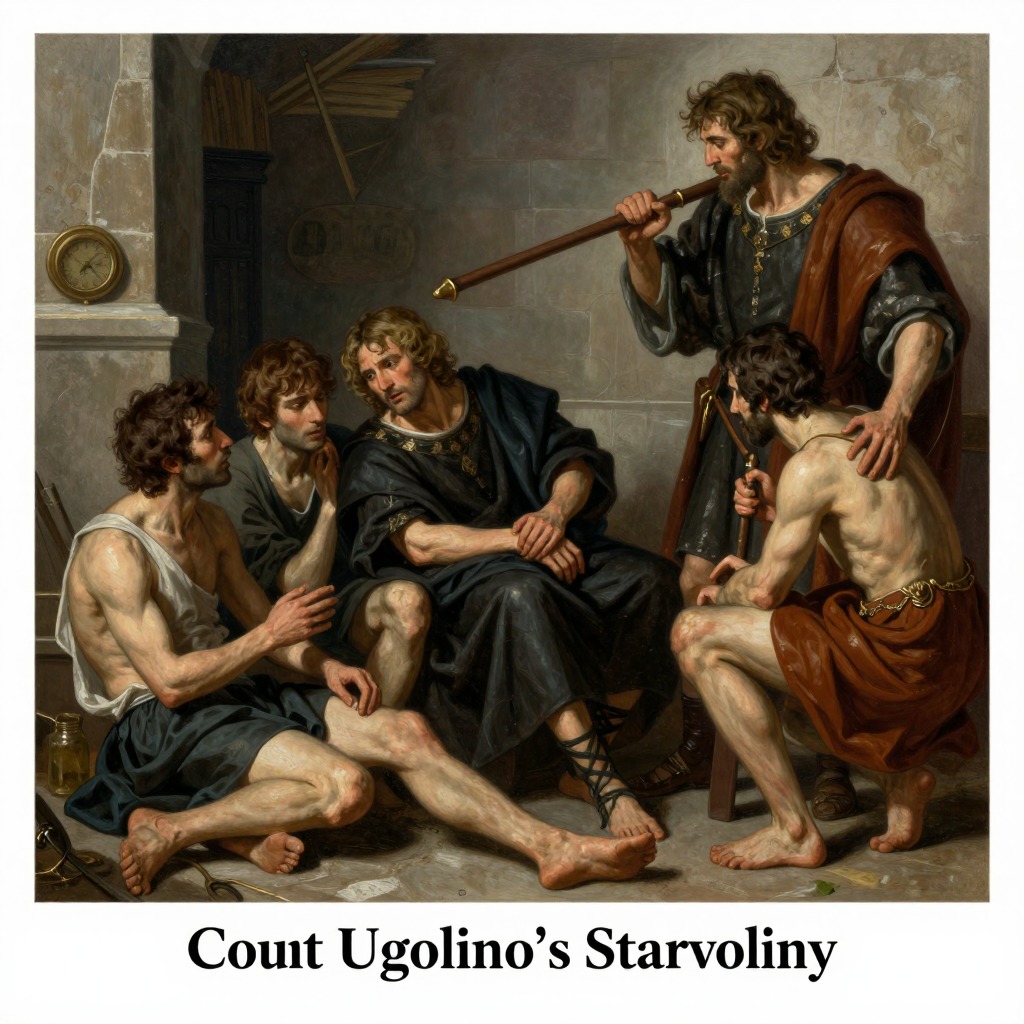
The most harrowing sight in Antenora is that of Count Ugolino gnawing the skull of Archbishop Ruggieri, his betrayer. Ugolino, a Guelph nobleman of Pisa, was imprisoned with his sons and grandsons in the Torre della Muda and starved to death after Ruggieri, his political ally, turned against him. In Hell, Ugolino's punishment mirrors his crime: he who betrayed his trust now feeds eternally on the one who betrayed him. Ugolino recounts his story in full — the dream of the wolf and whelps hunted by the hounds of Ruggieri's allies, the locking of the tower door, the slow death of his children one by one, and his own final surrender to hunger. The narrative is one of the most sustained and emotionally devastating in the Inferno, and it establishes Antenora as a place where the punishment is not merely physical but psychological, a perpetual reenactment of the betrayal that defined the sinner's life.
Narrative and Thematic Significance
Antenora serves as a crucial stage in Dante's descent into the ultimate depths of Hell. The encounter with Bocca reveals the poet's own political passions — Dante, a Florentine exile, shows no pity for the traitor who helped defeat his faction at Montaperti. The Ugolino episode, by contrast, evokes profound sympathy, complicating the reader's response and demonstrating Dante's ability to humanize even the damned. The zone also introduces the motif of the frozen tears, which will become more extreme in Ptolomaea and Judecca. Thematically, Antenora represents the sin of political betrayal, a crime that Dante, as a partisan of the Holy Roman Empire and a victim of Florentine factionalism, regarded with particular horror. The ice that seals the sinners' tears and the gnawing of Ugolino both figure the cold, sterile hatred that political treachery engenders — a hatred that consumes both the betrayer and the betrayed.